
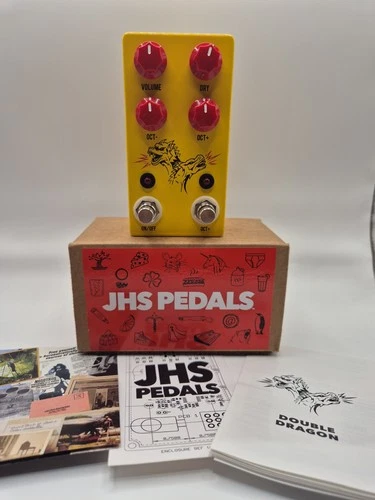
The JHS Double Dragon is a recent release from JHS Pedals: a lo-fi, all-analog octave pedal that is happy to misbehave. Here is what it does, who it suits, and where to put it on your board.
What is the JHS Double Dragon?
It is JHS Pedals’ first octave pedal, and Guitar World covered it in February 2026. It is an all-analog, monophonic octave device. That means it adds a lower octave and an upper octave to the notes you play, and it works best on one note at a time.
JHS says the design is built on classic analog octave-divider circuits of the kind found in the MXR Blue Box, Boss OC-2, Ibanez OT10 and Electro-Harmonix Micro-Synth.
What does it sound like?
- Lower octave (OCT−): a thick, vintage-style foundation under your notes.
- Upper octave (OCT+): a gritty octave-up distortion that JHS places somewhere between an Octavia and a Superfuzz.
- Chords: play them and the circuit stutters and jumps around. JHS treats that as part of the character, not a fault.
The controls
- Volume: master output, with extra boost on tap.
- Dry: mixes in your clean signal. Turn it right down for a fully wet, glitchy, synth-like sound.
- OCT− and OCT+: set how much of each octave you hear.
- Two footswitches: the left one turns the pedal on and off, and the right one adds the OCT+ voice. OCT+ only works while the pedal is on.
Who is it for?
Anyone who wants a messy, characterful octave rather than a clean, accurate one. JHS also says it works with bass, and it suits players who like their sounds a bit unpredictable.
Octave effects have a famous history. Roger Mayer built the Octavia for Jimi Hendrix, and it is linked to “Purple Haze”, recorded in London in February 1967. More recently, Royal Blood’s Mike Kerr uses octave pedals, including two Electro-Harmonix POG2 units, to turn a bass into a huge sound through both a guitar amp and a bass amp. To be clear, those players are examples of the octave sound, not people known to use the Double Dragon itself.
Where does it go in your pedal chain?
JHS suggests putting an overdrive after it, especially a mid-heavy Tube Screamer-style pedal, and a fuzz after that if you want more chaos. A pitch vibrato after it pushes the sound towards synth territory. As a starting point (our suggestion, not JHS’s): guitar, then Double Dragon, then overdrive or fuzz, then any delay and reverb.
How to get started
- Start with Dry fully up and the octave knobs low, then bring them in one at a time.
- Play single notes first. Use the right footswitch to bring in the OCT+ grit.
- Turn Dry all the way down for the full lo-fi synth effect.
Power and size
It runs on 9V DC, centre negative, and draws 75mA. Do not go above 9V. It measures about 2.6 x 4.8 x 1.6 inches, has top-mounted jacks and a silent buffered bypass.
Buying one used
Used pedals are a good way in. When you buy second-hand, check that both footswitches work, that the OCT− and OCT+ knobs sweep smoothly without crackle, and that it comes with its original box and paperwork if you care about resale value. Our current stock is on the guitar pedals page, including a mint, boxed JHS Double Dragon at the time of writing.
Got a pedal like this sitting on a shelf? We buy used pedals across Brighton, Hove and Worthing and by post. Get a free quote.
Sources: Guitar World, zZounds product listing, IEEE Spectrum, Guitar World on Royal Blood.
Leave a Reply